For months, General Hospital has quietly encouraged viewers to see Jack Brennan as one of the most dangerous men in Port Charles — a cold WSB bureau chief who lies, withholds information, and makes morally disturbing decisions without hesitation. On the surface, the evidence seems overwhelming. Jack misled others about critical missions, allowed key figures to disappear without explanation, and appeared disturbingly passive while Anna Devane vanished under suspicious circumstances. The narrative has been clear: Jack Brennan cannot be trusted.
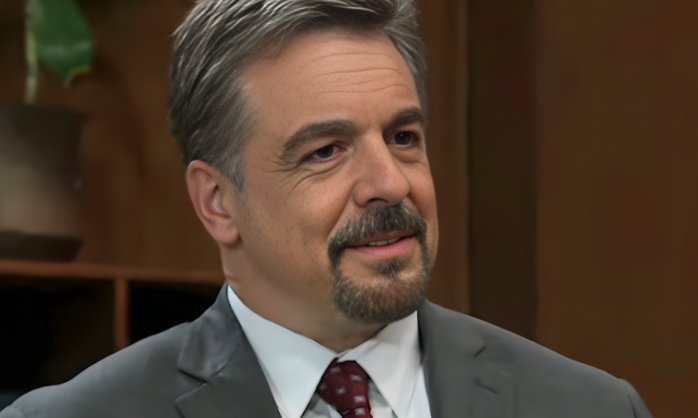
But the original SoapHub commentary challenges that assumption — and when examined closely, it opens the door to an even more explosive possibility. What if Jack Brennan isn’t the villain at all? What if he’s something far more dangerous to the WSB than any external enemy?
The article begins by acknowledging why fans turned on Jack so quickly. As a senior WSB official, his job is to protect agents and maintain transparency. Instead, he lied about Josslyn’s situation, allowed Vaughn to be erased from the board, and seemed strangely unconcerned about Anna’s fate. These are not small missteps; they are the kinds of actions that make a man look corrupt, cruel, or complicit. From a viewer’s perspective, Jack looked like yet another power-hungry operative willing to sacrifice lives for institutional convenience.
However, the narrative cracks open with the introduction of Ross Cullum, a figure positioned above Jack in the WSB hierarchy. Cullum is revealed as a direct superior to Sidwell — the man connected to Anna’s secret imprisonment at Windermere alongside Pascal. Crucially, Jack does not appear to know that Anna is being held captive. He has been told, through official channels, that she is on assignment. And he believes it.
This distinction is critical. If Jack were knowingly complicit in Anna’s captivity, the show would have framed his behavior very differently. Instead, the story presents him as someone operating on false intelligence. That doesn’t make him a hero — but it does mean his worst crime may be incompetence, not malice. As the original article suggests, being deceived by your own agency makes you a bad spy, not an evil man.
Yet this is where the story becomes far more interesting.
Because Jack’s mistakes are not reckless. They are contained, calculated, and strangely restrained. He doesn’t overreact. He doesn’t silence people permanently. He doesn’t escalate when escalation would benefit a true villain. Instead, Jack consistently occupies a gray zone — powerful enough to obstruct, but never brutal enough to destroy. That gray zone is exactly where double agents live.
If the WSB is no longer a traditional intelligence organization but a rogue power structure — one that detains agents off the books, manipulates information internally, and operates beyond accountability — then dismantling it would require something more than rebellion. It would require evidence. And evidence can only be gathered from inside.
This is where the double-agent theory becomes not only plausible, but narratively elegant.
Jack Brennan may not work for the WSB at all — not in the way we think. He may be embedded within it by a larger, unseen authority: a shadow oversight body, an international intelligence coalition, or a higher governmental mechanism designed to expose corruption that has metastasized beyond control. If that is the case, Jack’s true mission would not be to save individuals in the moment, but to document patterns, chains of command, and illegal operations until the entire structure can be taken down at once.
In that context, his silence becomes strategy. His apparent inaction becomes restraint. His willingness to look like the villain becomes the price of staying embedded long enough to finish the job.
The emergence of Ross Cullum reinforces this idea rather than contradicting it. Cullum does not feel like a final boss; he feels like a layer — a pressure valve meant to redirect blame and protect something even bigger. Jack doesn’t confront him directly because doing so would be premature. If Cullum falls too early, the real architects disappear. A double agent would know that patience is not cowardice; it’s survival.
Most importantly, this interpretation reframes Jack’s potential role in Port Charles itself. Justice in Port Charles has always been fragile, personal, and delayed. Institutions fail. Courts collapse. Truth surfaces only after enormous damage is done. If the WSB has become a “bomb” buried beneath the city — powerful, unstable, and capable of destroying everyone connected to it — then Jack Brennan may be the only character positioned to defuse it.
Not by heroics. Not by confession. But by exposure.
The original article asks whether Jack is truly as bad as we think. The deeper answer may be far more unsettling: Jack Brennan may be the key to justice in Port Charles, even if that means he must be hated until the very end. If he is a double agent, then every suspicious move has been a step toward something larger — not the protection of power, but its dismantling.
And if that’s true, then the biggest twist still ahead isn’t Jack’s betrayal.
It’s the moment the WSB finally falls — and we realize Jack was never protecting the system.
He was preparing to destroy it.
