Willow did not act out of panic after Drew collapsed — she acted out of control. The moment she injected him, she understood that survival depended not on escape, but on narrative, and she chose one that would shut down questions instantly. Instead of confusion or hysteria, she delivered a story that medical professionals are trained to accept without hesitation: stroke symptoms. Slurred speech, facial droop, sudden collapse — she didn’t guess, she selected, and that choice ensured that from the first second Drew entered the hospital, everyone would be looking forward at treatment instead of backward at cause.

What makes Willow’s lie so dangerous is not just that it sounded believable, but that it was strategically constructed to trigger protocol. Stroke is not debated in emergency rooms, it is obeyed. Once that word enters the chart, the focus becomes speed, scans, stabilization, and outcome, not investigation. Willow understood that doctors wouldn’t interrogate a grieving partner while racing the clock, and she used that urgency as a shield, hiding her actions behind medicine itself.
Her performance at the hospital was just as calculated as her medical explanation. Willow didn’t overreact or collapse dramatically; she calibrated her fear. She cried enough to look human, hesitated enough to appear shocked, and spoke in fragments that invited comfort rather than suspicion. By allowing others to console her, she reversed the power dynamic — the moment people reassure you, they stop questioning you, and Willow leaned into that instinct flawlessly.
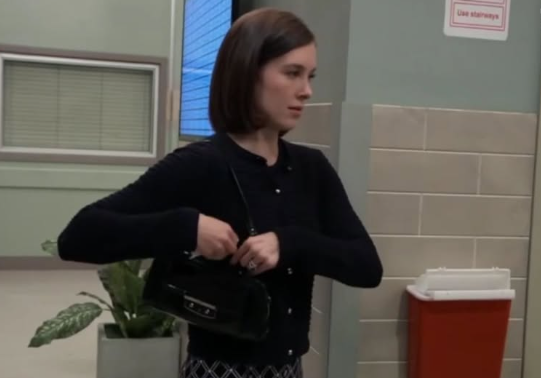
The most revealing detail was not what Willow said, but what she quietly removed. The needle did not remain as evidence, it vanished into a place where no one would think twice. That single act proves this was never a reckless impulse but a contained operation. Panic leaves messes. Willow left none. Every step after the injection served one purpose: making sure Drew’s condition could never be traced back to her hands.

This is why Willow is no longer just a troubled character — she is a silent threat. She doesn’t intimidate or rage or demand loyalty; she rewrites reality while wearing the mask of concern. If Drew wakes up unable to speak or move, her story becomes permanent, because truth requires a witness, and Willow has already positioned herself as the only one who can speak for him.
In the end, the most chilling part of this storyline is not the act itself, but the ease with which Willow lived inside the lie. She didn’t flinch, didn’t correct herself, didn’t spiral. She adapted. And in a world like Port Charles, where truth often survives only through confession or confrontation, Willow has engineered a scenario where neither may ever come.
