Claire has spent months presenting herself as the sweet, traumatized Newman princess, the “good girl” who survived Jordan’s manipulation and deserved a fresh start. But her recent obsession with Audra and Holden is raising a chilling question among fans: is Claire seeking the truth, or is she desperately trying to hide her own guilt? A growing theory suggests that Claire isn’t a victim anymore—she’s projecting her darkness onto others.
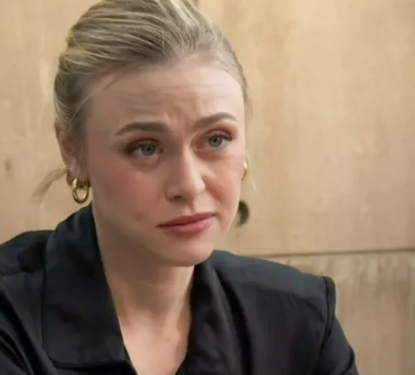
Psychologists call this behavior projection. When someone cannot face their own guilt, shame, or violent past, they displace those feelings onto someone else. Instead of confronting their own sins, they obsessively accuse and investigate others. Claire fits this pattern disturbingly well. She poisoned and killed her aunt in a calculated act, yet she now positions herself as the moral judge of Audra and Holden. Fans are starting to wonder if her crusade against Audra is less about justice and more about denial.
Audra represents everything Claire refuses to admit about herself. Audra is ambitious, morally gray, unapologetic, and honest about her flaws. Claire, in contrast, clings to an image of purity and superiority. She wants to be seen as the refined, ethical Newman princess. But beneath that polished surface lies a woman capable of manipulation and cruelty. That’s why Audra unsettles her so deeply. Audra is the mirror Claire refuses to look into, the embodiment of the darkness Claire pretends she doesn’t have.
Claire’s behavior with Holden only intensifies this theory. Their relationship was new, yet she pushed relentlessly for details about his past. She demanded transparency, interrogated him about Audra, and reacted harshly when he hesitated. This wasn’t romantic curiosity. It was a quest for control. Information gives Claire power, and power gives her security. If she knows everything about Holden and Audra, she can control the narrative, cast herself as the victim, and keep her own secrets buried.
The hypocrisy is impossible to ignore. Claire condemns Audra for deception and Holden for potentially criminal behavior, yet she herself committed deliberate murder. By focusing on others’ sins, she avoids confronting her own. This is classic soap opera villain psychology: the louder the moral outrage, the deeper the unresolved guilt. Fans are noticing that Claire’s righteous fury feels less like justice and more like performance.
Jordan’s shadow looms large over this storyline. Many viewers believe Claire is Jordan’s true legacy—not just emotionally or genetically, but behaviorally. Jordan was calm, calculating, and psychologically manipulative. Claire is beginning to exhibit the same traits. Her cold stare, methodical investigation, and emotional detachment feel eerily familiar. Soap operas thrive on generational villains, and with Victor aging, Claire could be the next strategic Newman power player—a villain shaped by trauma, privilege, and denial.
Another layer of this theory suggests that Claire’s obsession is rooted in fear. If Holden’s past crimes are exposed—especially if they involve death, cover-ups, or moral ambiguity—Claire may see herself reflected in him. That reflection could shatter her self-image as the “good girl.” So she attacks first, investigates first, condemns first. In soap logic, the best defense is always a preemptive moral assault.
Fans are also re-evaluating Claire’s past with Kyle. Her refusal of his proposal once seemed noble and self-aware. Now, many viewers think Kyle may have dodged a bullet. Claire’s escalating need for control, her fixation on Harrison, and her moral superiority complex suggest a partner who demands perfection while hiding imperfections. Soap history is full of sweet girls who evolve into controlling, manipulative partners. Claire may be following that exact blueprint.
What makes this theory so compelling is that it doesn’t rely on a sudden villain twist. It’s a slow burn. Claire isn’t suddenly evil; she’s gradually revealing who she has always been beneath trauma and privilege. Writers may be crafting a modern villain origin story built on psychological complexity rather than cartoonish evil. If this arc continues, Claire could become one of the most layered antagonists Y&R has seen in years.
So the real question isn’t whether Audra is dangerous. The real question is whether Claire is terrified of what she sees in Audra—and what that says about herself. Is she the hunter exposing darkness, or the monster trying to hide it? If this theory is right, Claire isn’t just digging into Audra’s past. She’s desperately trying to bury her own.
