On General Hospital, desperation has always been a dangerous catalyst, but what Britt Westbourne is contemplating now may be her most reckless move yet. Faced with the brutal progression of Huntington’s disease and the sudden disappearance of her medication, Britt is no longer willing to wait for help. Time is not just ticking; it is closing in. The question is no longer whether she will act, but how far she is willing to go. And the answer is terrifying.
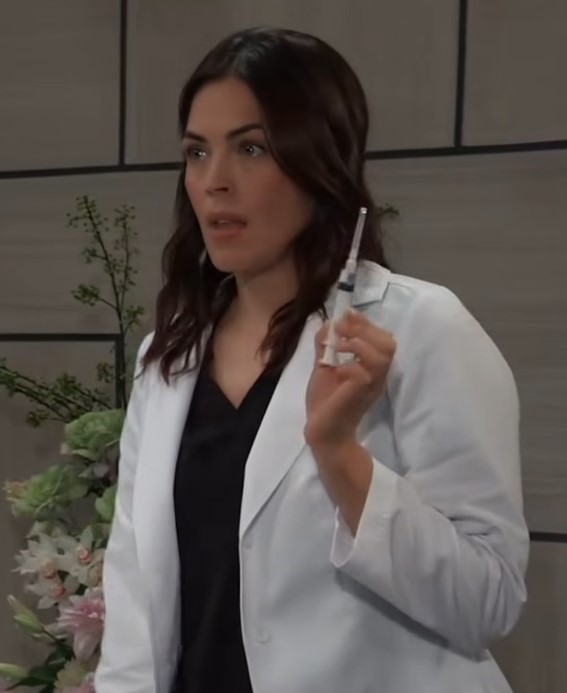
Britt’s crisis begins with a simple but devastating reality: she cannot access the medication that stabilizes her condition. Every missed dose is a reminder that her body is betraying her. Huntington’s is not patient. It does not pause for logistics, bureaucracy, or moral hesitation. In that suffocating pressure, rational thinking begins to erode. For Britt, this is not about convenience. It is about survival. The longer she waits, the greater the risk to her health, her clarity, and ultimately her future.
Lucas Jones wants to help her. He promises he will find the medication. He insists she give him more time. But time is the one resource Britt does not have. Lucas’ cautious approach, while logical, feels like paralysis to someone watching her own clock run out. Britt’s faith in waiting has evaporated. She cannot afford optimism. She needs action. When she realizes that even Marco is unaware of what Lucas is attempting, it reinforces her belief that she is fundamentally alone in this fight.
That isolation pushes Britt toward a shocking solution. Instead of waiting to be injected again under someone else’s control, she prepares a syringe of sodium pentathol. The symbolism is clear. She is done being the passive patient. If Pascal holds the power through those injections, Britt intends to flip the dynamic. Her plan is simple in theory but explosive in consequence: the next time he administers her shot, she will give him one of his own. It is retaliation wrapped in strategy.
But what is Britt truly trying to accomplish? On the surface, it appears she wants information. Sodium pentathol is known as a truth serum. If Pascal knows where her medication is being kept or who is manipulating access to it, forcing him to talk could solve everything. Yet beneath that practical objective lies something deeper. This is about reclaiming agency. Britt has always struggled with control, both in her professional life and her personal relationships. Facing a degenerative illness strips away autonomy in ways that are humiliating and terrifying. By orchestrating this plan, she regains a sense of dominance, even if only temporarily.
The risks, however, are monumental. If Britt is caught, the professional consequences would be catastrophic. She could lose her medical license, her reputation, and possibly her freedom. Administering a drug without consent is not a minor misstep. It is a crime. Worse, Lucas could become collateral damage. His attempt to help her might be reinterpreted as conspiracy. One desperate act could implode multiple lives. Britt knows this. The fact that she proceeds anyway underscores just how cornered she feels.
Emotionally, Britt is not just battling Pascal or the system. She is battling herself. Her pride has always been both her armor and her weakness. Accepting vulnerability has never come easily to her. Admitting she is afraid would mean acknowledging that Huntington’s is winning. Instead, she channels that fear into defiance. When she insists she is running out of time, it is not melodrama. It is raw truth. Her decision to act is less about vengeance and more about refusing to be powerless.
There is also the haunting possibility that her plan could spiral beyond her control. What if Pascal is not the mastermind? What if exposing him triggers a larger scheme? In Port Charles, secrets rarely exist in isolation. Britt may believe she is targeting a single obstacle, but she could be pulling a thread that unravels something far bigger. That is the danger of acting under extreme pressure: tunnel vision can blind even the smartest doctor.
If Britt succeeds, the victory would be transformative. She would secure her medication and reestablish control over her treatment. It would reaffirm her intelligence and resourcefulness. She would prove that she refuses to be victimized. But if she fails, the fallout could define her permanently. A single impulsive decision could brand her as unethical, unstable, or dangerous. Redemption might not come easily.
Ultimately, Britt’s plan forces a difficult question. Is she a hero fighting for her right to live, or a woman so consumed by fear that she is willing to burn everything down? On General Hospital, the line between bravery and recklessness is razor thin. Britt Westbourne is standing directly on it. And one move in either direction could change her life forever.
