From the moment Cassius entered the story, he was framed as a dangerous extension of Sidwell’s power, a controlled asset designed to keep Britt exactly where they wanted her. But something never fully aligned. His presence carried tension, yes, but not the kind that signals pure villainy. Instead, there was restraint, a subtle hesitation that stood out in a world where true antagonists act without pause. That disconnect is where the theory begins: Cassius was never meant to be the monster we were told he was.
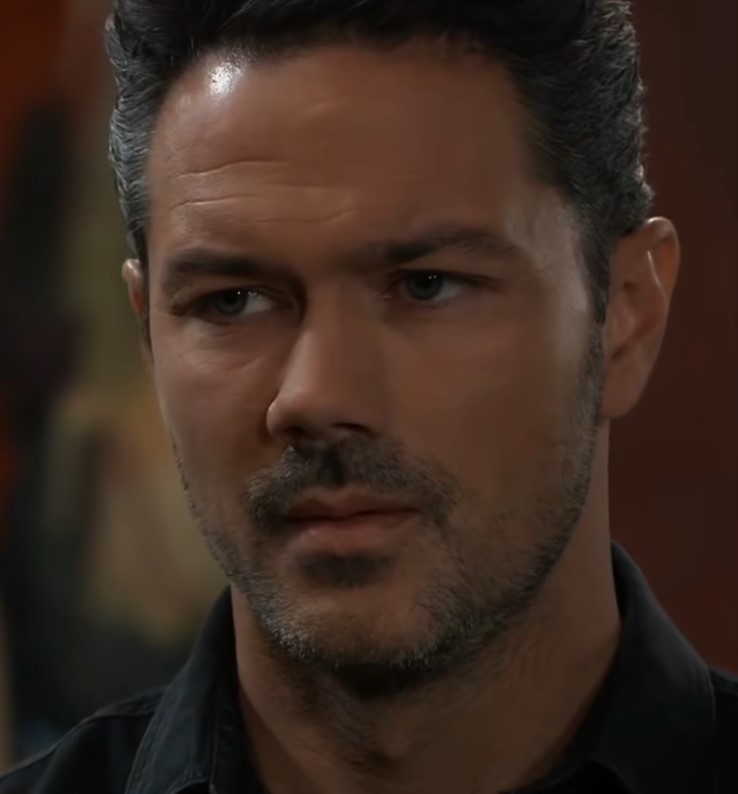
One of the earliest clues lies in how Cassius interacts with Britt. He doesn’t dominate her, doesn’t intimidate her the way Sidwell or Cullum do. Instead, there are moments where his gaze lingers just a second too long, where his reactions feel measured rather than instinctive. In soap storytelling, hesitation is never accidental. It is a signal. Cassius doesn’t look like a man enforcing control. He looks like someone fighting against it.
Another critical detail is his distance from the most brutal aspect of Britt’s imprisonment: the Huntington medication. While Sidwell and Cullum weaponize the drug to maintain absolute control, Cassius is never positioned as the one directly administering or withholding it. This is a deliberate writing choice. By keeping his hands clean of the most overt cruelty, the narrative preserves his moral ambiguity. It leaves space for redemption, suggesting that he was never fully committed to the system he appears to serve.
Then there’s the Rocco factor, a detail many viewers initially overlooked. Cassius had opportunities to cause harm, to assert dominance, to prove loyalty. He didn’t. In fact, his restraint around Rocco quietly establishes a boundary. In the language of General Hospital, characters who protect children are rarely beyond saving. It’s a subtle but powerful signal that Cassius operates under a different internal code than the villains around him.

His timing throughout the storyline adds another layer to the theory. Cassius doesn’t appear randomly. He shows up at moments of peak tension, particularly when Britt is most vulnerable. On the surface, this could be read as surveillance. But the pattern feels too precise, too intentional. It begins to resemble protection rather than control, as if he is always nearby not to trap her, but to make sure she survives.
Even in his interactions with Sidwell, Cassius never exhibits true loyalty. There is no fanaticism, no emotional investment in the mission. Instead, he maintains a cold, detached demeanor, as though he is playing a role rather than living it. In long-form storytelling, this kind of emotional distance often signals a double agent. He follows orders, but he never embodies them.
The dialogue reinforces this interpretation. Cassius frequently speaks in half-truths, delivering lines that sound like warnings disguised as threats. When he tells Britt she doesn’t understand what’s at stake, it doesn’t land as manipulation. It lands as frustration, as if he knows more than he can safely reveal. This pattern of incomplete honesty is a classic narrative device, hinting that his true intentions are being deliberately concealed.
The blood connection, if confirmed, becomes the most powerful motivator of all. If Cassius is indeed Nathan’s twin, then Britt is not just a liability or an asset. She is family. And in the world of General Hospital, family bonds override even the most dangerous alliances. This revelation doesn’t just complicate his role. It redefines it entirely. Suddenly, every restrained action, every moment of hesitation, begins to look like protection rather than compliance.

Marco’s death may be the turning point that pushes Cassius over the edge. Up until that moment, the system still functioned within certain limits. But when Cullum eliminates Marco and destroys Britt’s only chance at freedom, those limits vanish. The illusion of control is replaced by pure brutality. For someone already wavering, this kind of escalation can trigger a complete break. It is the moment where following orders becomes impossible to justify.
All of these details build toward a larger theory: Cassius was never truly part of Sidwell’s system. Whether he entered it willingly as an undercover player or was forced into it and gradually awakened, the result is the same. He exists inside the machine, but he does not belong to it. And that makes him the most dangerous variable in the entire storyline.
When the betrayal comes, it won’t be random. It will be inevitable. It may happen in the form of a direct defiance, a refusal to carry out an order against Britt. It may come as a calculated risk, stealing the medication that keeps her alive. Or it may unfold as a deeper deception, where Cassius appears to turn on her only to guide her out of Sidwell’s reach. No matter the form, the outcome points in the same direction.
We were told Cassius was the threat. But the story has been quietly telling us something else all along. He is not the weapon. He is the flaw in the system. And when he finally turns, it won’t just save Britt. It will collapse everything Sidwell built from the inside.
