What looked like a simple refusal in the April 24 episode may have been something far more dangerous. Liesl Obrecht didn’t just turn Felicia down—she revealed, in a single carefully chosen line, that she knows more than she is willing to admit. The entire tone of the scene shifts when you rewatch it with that lens. This wasn’t hesitation. This wasn’t indifference. This was controlled silence from someone guarding a truth that could blow everything open.
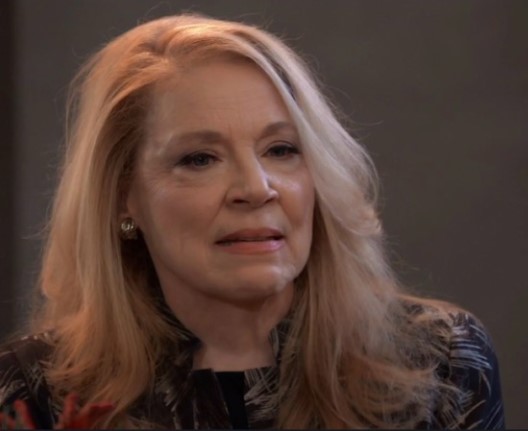
Felicia approached Obrecht out of desperation, hoping that a familiar face might break through to Anna, who is spiraling under the belief that she is surrounded by enemies tied to Faison. The situation is urgent, emotional, and deeply personal. And yet Obrecht’s response is immediate and firm. She doesn’t consider the idea. She doesn’t weigh the risks out loud. She shuts it down. That kind of certainty, in a situation filled with unknowns, doesn’t come from guesswork. It comes from knowledge.
The reasoning Obrecht gives only deepens the mystery. She claims that her presence would worsen Anna’s paranoia and potentially make Felicia look like part of the conspiracy. On the surface, it sounds logical—even protective. But the precision of that prediction raises questions. Obrecht isn’t just speculating about Anna’s state of mind. She is anticipating exact consequences, almost as if she already understands the mechanics behind what Anna is experiencing. That level of confidence suggests she’s not operating blindly.
Then comes the line that changes everything. Obrecht admits that if anyone could return from the dead, it would be Faison. This isn’t framed as a joke or a dismissal. It’s delivered as a possibility. And that’s the crack in the story. If Obrecht truly believed Anna was delusional, she would shut that door completely. Instead, she leaves it open—just enough to suggest that Anna’s fears may not be entirely unfounded. It’s a subtle shift, but it’s impossible to ignore.
Even more telling is Obrecht’s emotional response. She doesn’t laugh off Anna’s claim of seeing Faison. She admits it concerns her. That word matters. Concern means doubt. Concern means uncertainty. It means part of her believes there is something real behind Anna’s claims. In that moment, Obrecht stops being the rational outsider and becomes someone who is quietly afraid of what might be true. And that fear doesn’t come from nowhere.
Josslyn picks up on it immediately. When she stops Obrecht before she leaves and asks whether someone could be impersonating Faison—possibly even her son—it doesn’t feel random. It feels like a direct reaction to everything Obrecht just revealed without meaning to. Josslyn hears the hesitation, the contradiction, the carefully avoided answers. And instead of accepting the surface explanation, she pushes deeper. That question doesn’t come out of thin air. It comes from instinct—and from recognizing that Obrecht is hiding something.
This is where the theory begins to take shape. Obrecht may already know that someone is using Faison’s identity, or at the very least exploiting his legacy. Her refusal to get involved suddenly looks less like caution and more like containment. If she steps into the situation, she risks confirming Anna’s fears—or exposing a truth she’s trying to keep buried. And if her son is somehow connected, her silence becomes even more loaded.
What makes this even more compelling is that Obrecht never actually lies. She doesn’t deny the possibility. She doesn’t dismiss Josslyn’s suspicion outright. Instead, she redirects, deflects, and exits. It’s a classic move from someone who cannot reveal what they know but also cannot bring themselves to fully deny it. That kind of response is rarely accidental.
Now all eyes shift to Josslyn. She’s the one asking the right questions, the one refusing to accept easy answers. While everyone else is focused on whether Anna is losing her grip on reality, Josslyn is starting to look at the bigger picture. If there is a larger manipulation at play—if someone is using Faison’s name, voice, or legacy—she’s the one most likely to uncover it.
In the end, the real twist isn’t Anna’s supposed delusion. It’s Obrecht’s silence. Because the most revealing thing she did in that entire scene wasn’t what she said. It was what she chose not to say. And now, thanks to one slip and one question, the truth may be closer than ever to being exposed.
