Isaiah may have just made the biggest mistake of the entire mystery — not by hiding evidence, but by creating it. The moment he deliberately dragged his own vehicle against the guardrail near the hospital parking structure, the entire situation changed. Nothing about that scene felt random. It didn’t look like a distracted driver clipping a barrier by accident. It looked measured. Controlled. Almost rehearsed. And the most revealing part came afterward, because Isaiah didn’t try to keep the damage quiet. He immediately made sure Lucas saw it, discussed it, and remembered exactly how it supposedly happened. That is not the behavior of someone reacting emotionally in panic. That is someone planting a version of events before anyone else has the chance to question him.
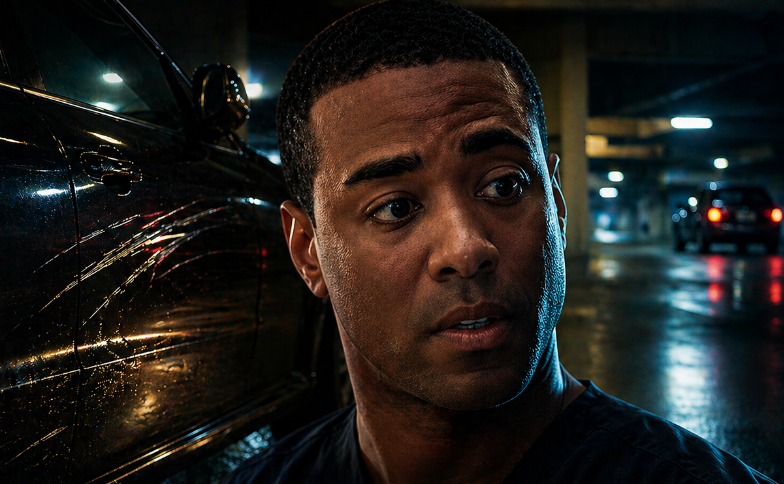
Because people do not manufacture explanations unless they are afraid of the truth. Isaiah’s actions suggest he understood something dangerous long before anyone else did. By showing the scratch immediately, he seized control of the timeline. He established where the damage came from, when it happened, and why it existed — all before suspicion could naturally form. It was a preemptive narrative. A carefully prepared answer to a question nobody had officially asked yet. And that detail alone changes everything, because innocent people usually wait until they are questioned. Isaiah moved first. That means he already knew the damage needed an explanation.
And once that possibility enters the conversation, the logic becomes extremely difficult to ignore. If Isaiah had absolutely nothing to do with the crash, then why would he risk drawing attention to his car at all. Why intentionally recreate visible damage unless there was already damage there to begin with. The most uncomfortable explanation suddenly becomes the simplest one. The scratch wasn’t created to fool Lucas into believing the car had been hit recently. It may have been created to cover the fact that the vehicle had already been damaged somewhere else entirely — somewhere far more dangerous. Somewhere connected to that night on the road when everything spiraled out of control.
The timeline surrounding Isaiah only deepens the suspicion. He was already positioned near the cabin around the time the accident occurred. He abruptly left under the explanation of an emergency house call, a detail that initially sounded harmless but now feels far more suspicious in hindsight. That excuse places him within striking distance of the crash itself. Add the damaged car, the urgency to explain it, and the strangely convenient timing surrounding the investigation, and the entire situation begins to feel engineered. It no longer resembles coincidence. It resembles reconstruction. Almost as if Isaiah has been quietly editing the story after the fact to make sure every detail points somewhere else.
What may truly expose him is not the physical evidence, but the psychology behind what he did. Innocent people generally defend themselves after accusations appear. They answer questions when investigators ask them. Isaiah behaved differently. He built the defense before suspicion had even fully formed. That kind of behavior usually comes from fear — or from knowledge nobody else is supposed to have. His actions suggest he wasn’t simply worried about looking guilty. He may already know exactly what investigators are eventually going to find.
And suddenly, the missing shape at the center of the mystery becomes impossible to ignore. For weeks, the story has hinted that another vehicle was present that night. Another driver. Someone who arrived, disappeared, and never fully accounted for their movements afterward. Someone who may have witnessed the crash… or contributed to it more directly than anyone realized. Isaiah now fits that outline almost perfectly. The location. The timing. The unexplained urgency. The suspicious damage. And most importantly, the effort to control how that damage would later be interpreted. Every piece begins pointing toward the same terrifying possibility.
But the deeper question may be why he fled in the first place. Not every hit-and-run begins with cruelty or intention. Sometimes panic takes over before logic has time to catch up. Maybe Isaiah believed the situation was smaller than it really was. Maybe he convinced himself it wasn’t technically his fault. Maybe he thought leaving for a few minutes would protect him from becoming involved in something catastrophic. But once he drove away, returning became far more dangerous than disappearing. Because going back would require answers. And answers create accountability. From that moment forward, survival may have mattered more to him than the truth.
That is why Isaiah’s strategy now feels so calculated. While public suspicion shifts toward Brook Lynn and theories continue spreading around other possible drivers, Isaiah remains strangely quiet in the background. Not invisible — just unnoticed enough to avoid becoming the primary target. Meanwhile, he appears to be adjusting details carefully, shaping perception piece by piece, making sure the spotlight never settles on him for too long. And ironically, that may become his downfall. Because in mysteries like this, the most dangerous person is often the one nobody realizes is steering the narrative from behind the scenes.
But the detail that could ultimately destroy everything is not the scratch itself. It is the timing of the scratch. If the original damage truly came from an innocent incident in the parking area, there would be no reason to recreate it in such a deliberate way afterward. The act of reproducing the damage may actually expose the existence of older damage he desperately needed to explain away. In other words, the moment Isaiah staged the second impact, he may have accidentally confirmed that the first one already existed.
Isaiah didn’t just create a lie to protect himself. He rebuilt the evidence around the lie. And that decision may end up becoming the exact clue that finally exposes the entire cover-up.
