After decades of emotional storytelling, Port Charles is facing a major turning point as Molly Burnett officially takes over the role of Maxie Jones, replacing Kirsten Storms. This is far more than a routine casting switch—it marks a profound shift for a character deeply tied to the identity of the show. For longtime viewers, the change challenges the sense of continuity they’ve relied on, forcing them to reconcile nostalgia with the inevitability of evolution.

The announcement didn’t come with a dramatic on-screen goodbye, but rather through a steady buildup of absence and speculation. Storms’ reduced appearances had already sparked concern, and now it’s confirmed that her exit is tied to ongoing personal health priorities. While a new chapter begins, the tone is bittersweet—this isn’t just a professional transition, but a deeply human one that resonates beyond the storyline.
Burnett, widely recognized for her work as Melanie Jonas on Days of Our Lives, steps into a role layered with years of emotional complexity. Maxie is not a blank canvas; she carries history, heartbreak, and resilience that have been carefully built over time. Burnett’s challenge is not imitation, but transformation—respecting what came before while crafting a version that feels authentic in its own right.
Storms’ absence in recent months created a noticeable void, one that fans tried to fill with theories and rumors. Speculation ranged from personal struggles to issues involving her ex-husband, Brandon Barash, but reducing her departure to gossip oversimplifies a nuanced reality. Her decision to step back reflects personal necessity, not scandal, and deserves to be viewed with empathy rather than sensationalism.
Behind every character is a real person navigating unseen challenges. Storms’ choice to prioritize her well-being should be met with understanding, not scrutiny. The urge to dramatize her absence says more about audience discomfort with uncertainty than it does about her situation. The show may continue, but the conversation surrounding her exit should remain grounded in respect.
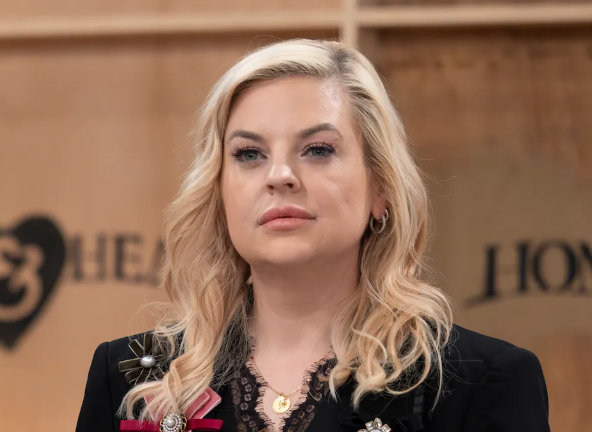
This transition raises a larger question that haunts all long-running series: can a character outlive the actor who defined them? Maxie Jones exists not just as a script, but as a performance shaped by Storms’ unique emotional depth. Whether Burnett can carry that legacy without losing its essence becomes the central tension of this recast.
Fans who have followed Maxie for years remember the subtle details—the vulnerability in her quiet moments, the emotional tremble in her voice, the strength she showed after heartbreak. Those elements are tied to memory, not easily replicated. Burnett’s success will depend on her ability to reinterpret rather than reproduce, finding her own emotional truth within the character.
The writers now face a crucial decision: how to handle this shift within the narrative. Will the transition be acknowledged directly, or quietly integrated into ongoing storylines? General Hospital has historically taken both approaches, and the path they choose will reveal how they value audience attachment and emotional continuity.
For longtime viewers, this is not an isolated event but part of a broader pattern. Recasts and departures accumulate over time, shaping how the show is experienced. Nostalgia becomes unavoidable, as fans hold onto earlier versions of characters even as new interpretations emerge. Yet change has always been part of the show’s DNA.
The recasting of Maxie is not a break from tradition—it’s an extension of it. The series thrives on disruption, on the tension between familiarity and reinvention. This moment asks viewers to accept both loss and possibility simultaneously, a balance that requires patience and openness.
Rumors surrounding Storms’ personal life add another layer of complexity, especially with lingering connections to Barash. While curiosity is natural, unchecked speculation risks creating narratives that may not reflect reality. It’s important to resist turning uncertainty into assumption.
Framing Storms’ future in negative or definitive terms does more harm than good. A reduced presence does not equal a downfall, and a recast does not signal collapse. These interpretations often reflect audience fears rather than actual circumstances.
What truly matters now is the direction of the story. Will Maxie continue to receive the depth she deserves, or will this transition overshadow her role? The writers have an opportunity to deepen her journey, using this moment as a catalyst for new emotional layers. Every scene will inevitably be compared to the past.
Burnett inherits a character shaped by years of storytelling, but she brings her own perspective. Her portrayal will not erase Storms’ legacy—it will build upon it. Whether audiences embrace this change depends as much on their willingness to adapt as it does on her performance.
At its core, this shift reflects a deeper emotional truth: stability is never guaranteed. For viewers who have grown attached to familiar faces, even small changes can feel unsettling. The key is distinguishing between what is real and what is imagined.
The story of Maxie Jones continues, even as one chapter closes and another begins. If General Hospital has proven anything, it’s that endings are rarely final. Characters evolve, stories return, and new paths emerge when least expected.
This casting decision is undeniably significant, but it is not the end—it is a continuation. A new era unfolds in Port Charles, carrying both the weight of the past and the promise of something new.
