Josslyn Jacks may have started her investigation out of curiosity, but what she is uncovering could reopen one of the darkest legacies Port Charles has ever faced. Her growing obsession with Cesar Faison is not just about understanding history. It is about confronting the terrifying possibility that history might be repeating itself — and perhaps in ways even more dangerous than before.
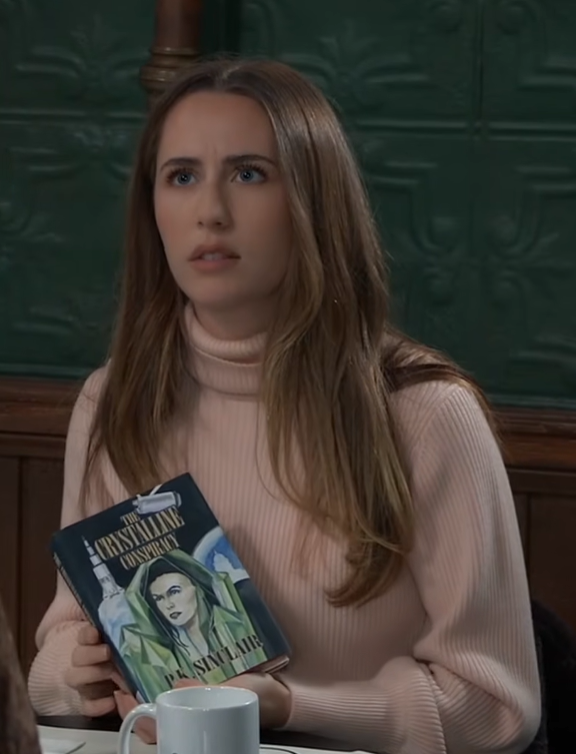
Josslyn’s discovery begins with something seemingly harmless: a book connected to Faison. However, in the world of Port Charles, objects tied to notorious figures rarely remain simple artifacts. The presence of the book at Wyndemere immediately raises red flags. Wyndemere itself is a symbol of legacy, secrets, and generational trauma. The fact that Josslyn found not only the book but also a pack of cigarillos linked to Faison suggests that someone is deliberately preserving his memory — or worse, staging a message meant to be discovered.
Her confrontation with Liesl Obrecht only deepens the mystery. Obrecht’s confirmation that Anna Devane was Faison’s singular obsession reinforces how deeply personal Faison’s crimes always were. He was never simply a villain seeking power or chaos. Faison thrived on psychological manipulation, emotional torment, and twisted romantic fixation. This detail becomes critical when analyzing Josslyn’s theory. If someone is indeed copying Faison, they may not just be recreating his methods. They may be replicating his psychological patterns, targeting individuals who mirror Faison’s original emotional fixations.
The inscription “For my muse” found alongside the book adds another chilling layer. The phrase is deeply personal, suggesting admiration, obsession, or even devotion. If the inscription is recent, it implies that whoever left it is not merely studying Faison. They are idolizing him. In Port Charles, obsession has always been a dangerous catalyst, particularly when tied to legacy villains. Josslyn’s suspicion that someone could be impersonating Faison reflects a broader pattern seen throughout the show’s history — the emergence of copycat criminals who seek notoriety by reviving infamous reputations.
One of the most unsettling elements of Josslyn’s theory is the possibility that this is not random. The items were discovered during a snowstorm, a setting often used symbolically in Port Charles to represent isolation, vulnerability, and hidden threats. The timing could suggest that whoever planted these clues wanted them to be discovered under dramatic circumstances. That raises the question: Was Josslyn meant to find them? If so, she may already be part of a larger psychological game.
Another layer to consider is the Cassadine connection. Wyndemere has long been a breeding ground for manipulation and legacy-driven schemes. If someone connected to the Cassadine family is behind this potential imitation, it would fit the pattern of using history as a weapon. Cassadine plots often revolve around resurrecting past enemies, exploiting emotional trauma, and maintaining control through fear. Josslyn’s investigation could unintentionally place her in the center of a Cassadine-style mind game.

There is also the possibility that this is less about Faison himself and more about what he represents. Faison’s legacy is rooted in chaos, obsession, and emotional destruction. A copycat might not aim to recreate his exact crimes but rather his impact — destabilizing key figures in Port Charles. Anna Devane, as Faison’s historic obsession, could once again become a psychological target. The reemergence of Faison symbolism could be designed to destabilize Anna, reopening old wounds and forcing her into a vulnerable emotional state.
Josslyn’s role in this storyline is particularly compelling because she represents the next generation of Port Charles. Her curiosity and determination mirror the investigative instincts of characters like Anna and Laura, but she lacks their experience navigating legacy villains. This creates a dangerous dynamic. Josslyn may believe she is uncovering the truth, but she could unknowingly be stepping into a trap designed to lure her deeper into a psychological maze.
There is also a broader thematic question raised by Josslyn’s theory: Can evil truly die in Port Charles? Faison’s confirmed death should have closed that chapter permanently. Yet, the continued presence of his symbolism suggests that his influence remains alive through memory, trauma, and those who romanticize his legacy. Soap opera history repeatedly demonstrates that villains often outlive their physical existence through emotional and psychological echoes.
If Josslyn’s theory proves correct, the stakes could extend far beyond a simple impersonation. A true Faison imitator would likely possess deep knowledge of his methods, relationships, and psychological warfare tactics. That level of preparation suggests someone with access to hidden history, personal archives, or insider knowledge of Faison’s past. Such a revelation could expose connections that reach into some of Port Charles’ most powerful families.
Ultimately, Josslyn’s investigation may not just uncover a copycat. It may reveal how legacy villains continue to shape the present long after their deaths. By pursuing this mystery, Josslyn is stepping into a generational battle between past and future. Whether she becomes the one to end Faison’s lingering shadow or the next victim caught in it remains one of the most chilling possibilities looming over Port Charles.
