The comparison between Diane Miller and Ironside may sound dramatic at first, but for long-time television fans, it carries a powerful legacy. When a fan declared, “If Ironside could do it, so can Diane,” they weren’t just cheering on Carolyn Hennesy’s recovery. They were calling for a bold new era of storytelling on General Hospital—one that could redefine how the show portrays power, disability, and resilience.
Ironside, played by legendary actor Raymond Burr, was one of the earliest television characters to normalize disability without stripping away authority. Confined to a wheelchair after being shot, Detective Robert Ironside remained a commanding force, directing investigations with intellect and presence. He was never written as weak or sidelined. Instead, his disability became part of his identity, not a limitation on his narrative importance. That legacy is exactly what fans now see reflected in Diane Miller’s current situation.
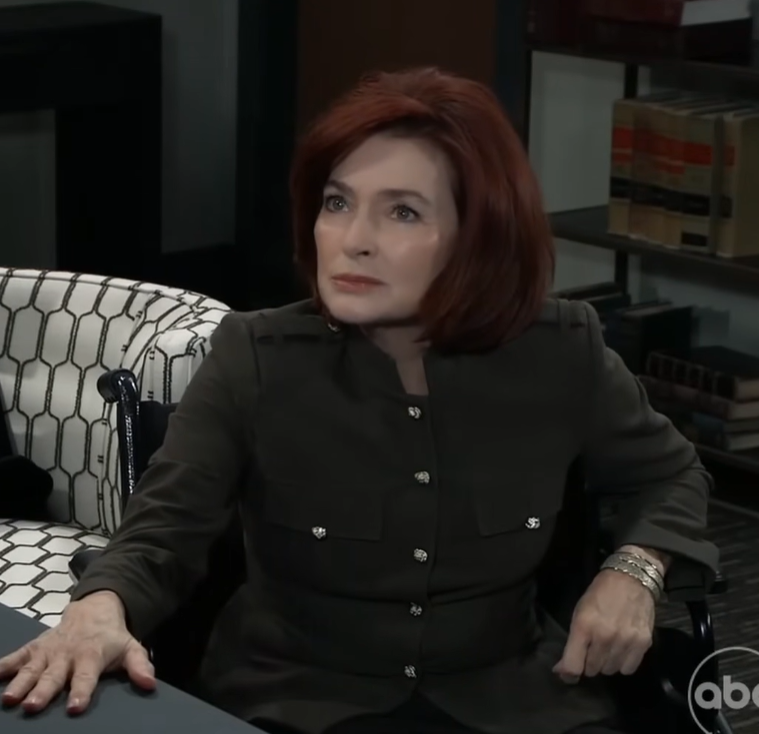
Carolyn Hennesy’s real-life leg injury, which has temporarily placed her in a wheelchair on General Hospital, has sparked intense discussion within the fandom. Rather than hiding the injury, the show incorporated it into Diane’s on-screen life. This creative choice opened the door to something rare in soap storytelling: a powerful, sharp-tongued female character navigating the world with a visible disability while retaining her dominance in the courtroom and beyond.
For fans, the Ironside comparison is not just nostalgic—it is aspirational. Diane has always been one of Port Charles’ most formidable minds, a legal shark who rarely loses and never backs down. Seeing her in a wheelchair could have easily been framed as a vulnerability arc, but fans are demanding the opposite. They want Diane to become stronger, more strategic, and even more intimidating. In their eyes, this is her Ironside moment—a chance to evolve into a symbol of power that transcends physical limitations.
This reaction also reflects a broader shift in television audiences. Modern viewers are increasingly critical of how disability is portrayed on screen. They are tired of pity narratives and sidelined characters. They want representation that feels authentic and empowering. Diane’s storyline offers General Hospital an opportunity to lead in this space, especially within the soap genre, which has historically struggled with nuanced disability representation.
There is also a meta-layer to this conversation. Fans are not only speaking to the character but to the writers and producers. By invoking Ironside, they are sending a message: do not waste this moment. Do not turn Diane into a background character or a temporary plot device. Instead, use this as a chance to deepen her influence in corporate wars, courtroom battles, and personal conflicts. A wheelchair should not reduce Diane’s narrative gravity; if anything, it should amplify it.
Speculation is already swirling about potential story arcs. Could Diane become the ultimate legal puppet master, orchestrating major corporate and criminal battles from behind the scenes? Could her physical limitation push her into a more strategic, chess-master role, manipulating Port Charles power players with ruthless precision? Fans are already imagining a “Wheelchair Queen” era where Diane becomes untouchable, feared, and more central than ever.
The Ironside reference also taps into a powerful emotional undercurrent. Carolyn Hennesy’s real-life recovery journey has inspired viewers who have faced injuries or disabilities themselves. Seeing a beloved actress return to work, integrated seamlessly into the narrative, resonates deeply. It transforms a behind-the-scenes challenge into a story of resilience, visibility, and empowerment, both on-screen and off.
Ultimately, the question is not whether Diane can be the new Ironside. It is whether General Hospital is willing to embrace that potential. The ingredients are all there: a beloved character, a real-world challenge, a passionate fanbase, and a legacy television archetype to draw from. If handled correctly, Diane’s current arc could become one of the most meaningful and talked-about storylines in recent GH history.
Fans have made their stance clear. They don’t want Diane sidelined. They want her elevated. They want a wheelchair queen who dominates courtrooms, corporate boardrooms, and narrative center stage. And if Ironside proved anything decades ago, it’s that power is not defined by mobility—it’s defined by presence, intelligence, and storytelling courage.
If General Hospital dares to listen, Diane Miller’s Ironside era could be legendary.
