Curtis hesitated. That single pause before signing away the house said more than any dramatic confession ever could. Viewers immediately assumed regret. They saw a man realizing he was losing Portia, losing the family home, losing the life he once fought to build. But what if that moment was not about love at all? What if it was about control? Curtis may not be grieving Portia. He may be reacting to the uncomfortable reality that he is no longer the center of the story.
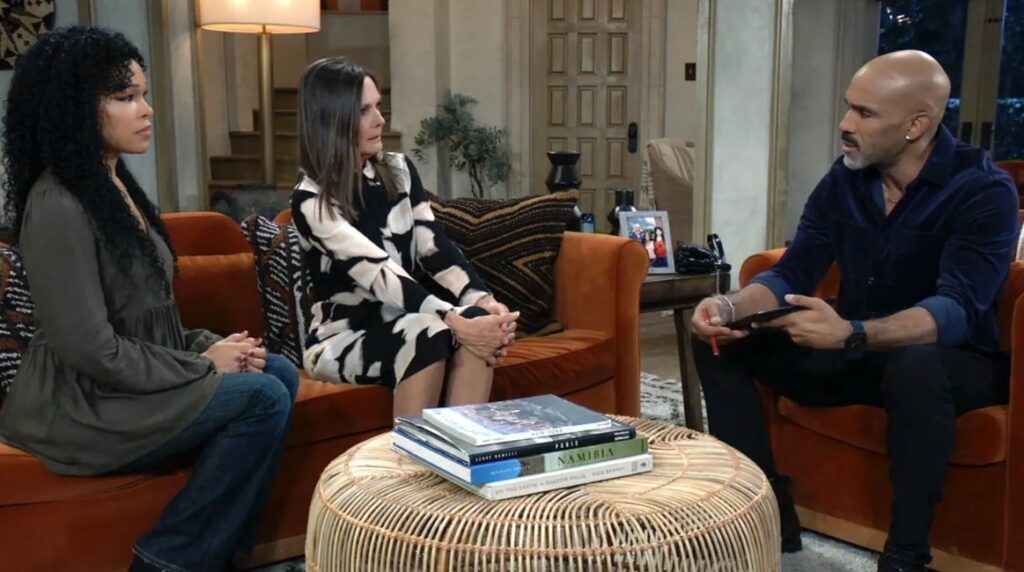
For years on General Hospital, Curtis has followed a pattern that is becoming impossible to ignore. When he is secure in one relationship, he drifts emotionally toward the other. When Jordan was in his life, unfinished business with Portia lingered. When he finally built a future with Portia, doubts crept in. Now that the divorce feels real and final, he is suddenly reflective, hesitant, almost sentimental. This is not necessarily the behavior of a man in love. It is the behavior of someone who struggles when he is no longer being chosen.
Curtis does not seem most passionate when he has stability. He seems most alive when something is slipping away. The tension, the possibility, the emotional tug-of-war — that is where he thrives. Being wanted by two strong women keeps him in a position of emotional power. Once that power fades, once someone decisively walks away, he becomes unsettled. The house represents more than bricks and memories. It represents permanence. And permanence forces decisions.
Now imagine the situation escalating in the most explosive way possible. What if Jordan discovers she is pregnant right now? The timing would be devastating. Curtis would no longer be floating between possibilities. He would be forced into a choice that carries lifelong consequences. Responsibility would replace ambiguity. There would be no emotional gray zone left to hide in.
If Jordan is pregnant and Curtis returns to Portia anyway, he risks appearing selfish, prioritizing his unresolved feelings over a child’s stability. If he stays with Jordan purely out of obligation, that raises another question: is he choosing love, or simply managing guilt? And if he hesitates yet again, unable to commit fully to either woman, the pattern becomes undeniable. Curtis would not be torn between two great loves. He would be stuck between his desire to be desired and his fear of being left behind.
This is where the psychology becomes uncomfortable. Curtis may not be in love with Jordan. He may not even be in love with Portia in the way he once believed. What he seems attached to is the feeling of significance. The reassurance that he matters. The security of knowing that if one door closes, another remains slightly open. But pregnancy changes the rules. A baby removes the luxury of indecision. It demands clarity.
Portia, for all her flaws, is capable of walking away if she believes the door is truly closed. Jordan, strong and independent, would not tolerate emotional half-measures forever. If a pregnancy storyline unfolds, both women would be forced to redefine their boundaries. And Curtis would finally face a scenario where he cannot orbit both lives at once. He would have to stand somewhere.
Perhaps the real question is not which woman Curtis will choose. The real question is whether he is capable of choosing at all. Does he want partnership, or does he want perpetual possibility? Does he crave commitment, or the adrenaline of emotional competition? A pregnancy would expose the answer quickly.
If Jordan is expecting, Curtis cannot remain the human ping pong ball bouncing between two histories. He would either step into responsibility with conviction or reveal that he has been clinging to emotional limbo all along. And if that happens, viewers may realize something shocking: the triangle was never about two women fighting for one man. It was about one man fighting to avoid losing his sense of importance.
So if the rumor becomes reality, the fallout will not just test loyalties. It will test Curtis’s character at its core. And for the first time, he may not be able to escape the consequences of what he truly wants — or what he has never been brave enough to admit.
