Right now, Anna Devane is being framed as unstable, paranoid, and unreliable. She has been isolated in France, her concerns dismissed as symptoms of PTSD, and her credibility quietly stripped away. From a procedural standpoint, it all sounds responsible: protect Anna, get her treatment, remove her from danger. But General Hospital has told this story before. And every time Anna was branded “too emotional” or “too close to the case,” history eventually proved that she was not imagining the danger — she was simply seeing it before everyone else did.
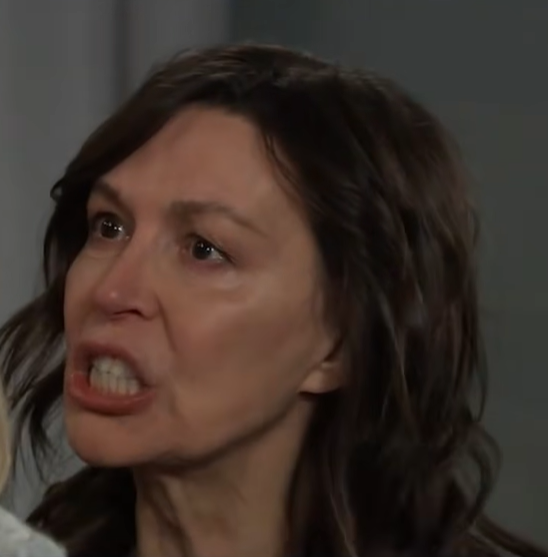
The current narrative insists that Anna has crossed a line. Her fixation on old ghosts, especially the name that still rattles everyone, is being used as proof that she has lost perspective. Dante Falconeri, speaking from a place of concern and personal experience, believes Anna’s fear is a trauma response, not a warning. The logic is simple: extreme stress plus unresolved PTSD equals paranoia. But this explanation only works if Anna’s instincts have not been reliable in the past. And that is where the story begins to unravel.
Anna Devane has a long history of being doubted right up until the moment she is vindicated. She has been sidelined, second-guessed, and even professionally undermined because her convictions were deemed too personal. Time and again, she was told to step back, trust the process, and let others handle the threat. Time and again, the threat turned out to be real. This is not coincidence. This is a pattern — one the show itself has established over decades.
The name at the center of this controversy is not just any villain. Faison is not a random fixation or a convenient symbol for Anna’s trauma. He is the embodiment of everything that has shattered her sense of safety, control, and trust. Yes, he triggers her PTSD. But he also represents a truth the town has repeatedly underestimated: that the most dangerous enemies are the ones everyone is certain are gone. The question fans should be asking is not why Anna is afraid of Faison — it is why everyone else is so eager to believe he could never return.
What makes this moment especially unsettling is the timing. Anna’s spiral did not happen in a vacuum. It emerged alongside resurfacing questions about Britt Westbourne and Nathan West, two losses that were never fully resolved emotionally or narratively. Anna is not clinging to the past because she refuses to move on. She is responding to a pattern of unfinished truths. When pieces that were supposed to be buried start shifting, Anna notices. She always does.
Declaring Anna unstable conveniently removes her from the board. It means her warnings no longer require investigation. Her instincts can be treated as symptoms. Her questions can be postponed indefinitely. And most importantly, if something truly dangerous is unfolding, Anna will not be in a position to stop it. That is not protection. That is containment. In the world of General Hospital, containment has often been the first step toward disaster.
There is also a deeply uncomfortable subtext to how this story is unfolding. Anna is a veteran agent, a survivor, and a woman who has carried more emotional weight than most characters on the canvas. Yet the moment she pushes back too hard, she is labeled unwell. The show has done this before with powerful women who refuse to ignore their instincts. Strength is celebrated until it becomes inconvenient. Then it is reframed as instability.
If Anna truly were delusional, the story would feel different. There would be cracks in her logic, contradictions in her memories, inconsistencies that undermine her certainty. Instead, what we see is clarity wrapped in fear. Anna does not say she knows Faison is alive. She says she is afraid he might be — and that fear is grounded in experience, not fantasy. That distinction matters.
So what if Dante is wrong? What if Anna is not losing her grip on reality, but tightening it? What if her so-called paranoia is actually pattern recognition honed by decades of survival? General Hospital has taught its audience one crucial lesson: Anna Devane is rarely wrong. She is simply early. And if history is about to repeat itself, then calling Anna “unstable” may turn out to be the most dangerous mistake of all.
