The backlash against Jordan’s reaction has been loud, brutal, and almost unanimous. Fans are calling her “over the top,” “dramatic,” even “a drama queen,” arguing that her injuries don’t look severe enough to justify the emotional spiral. On the surface, it feels like another classic soap overreaction stretched for airtime. But what if the audience is reading this completely wrong? What if the issue isn’t how Jordan is reacting—but why the writers are making her react this way?
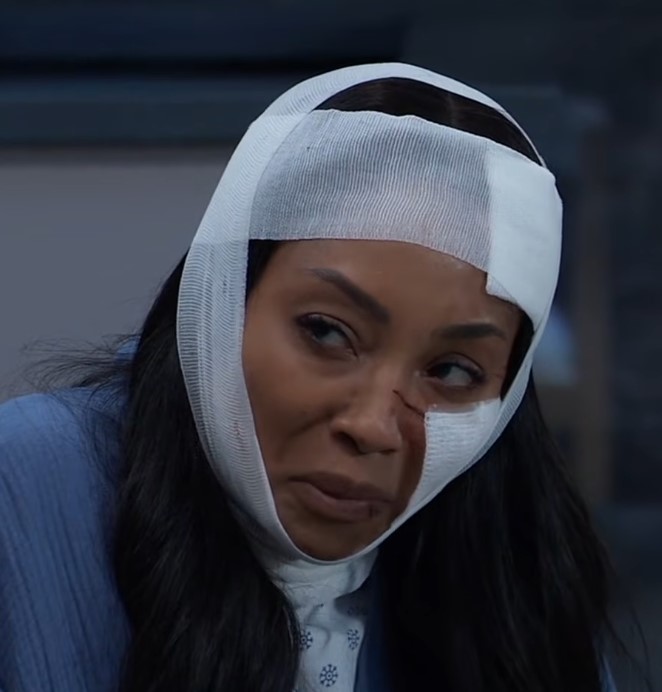
At the center of the criticism is a simple argument: the injury doesn’t match the response. Viewers point out that in a world where characters like Ava and Michael have come back from far worse without lasting scars, Jordan’s panic feels exaggerated. Many believe she hasn’t even given herself time to heal, jumping straight into worst-case scenarios before any real prognosis. But that logic only works if this story is about realism. In soap storytelling, exaggeration is rarely accidental—it’s usually a signal.
And that signal becomes clearer when you compare this version of Jordan to who she used to be. This is a character long defined by strength, composure, and control. She was never portrayed as vain or fragile. Yet now, she’s unraveling, obsessing over her appearance, and isolating herself emotionally. That shift isn’t just noticeable—it’s jarring. In soap language, when a character suddenly feels “off,” it often means something bigger is being set in motion behind the scenes.
This is where a classic soap trope starts to come into focus: disfigurement as a gateway to transformation. Daytime history is filled with characters who suffer facial injuries, disappear for treatment, and return with a completely new face—and often a new actor. It’s one of the oldest tricks in the genre, and fans are already picking up on it, speculating that Jordan’s storyline could be leading directly to a recast. The injury isn’t the endgame—it’s the setup.
What makes this theory even more compelling are the subtle narrative clues embedded in the writing. Jordan keeps circling the same fear: that she won’t recognize herself anymore. That she won’t be the same person. On the surface, it sounds like insecurity. But underneath, it reads like foreshadowing. The show isn’t just telling us she feels different—it’s preparing us to accept that she will be different. That distinction matters.
There’s also the visual storytelling. The heavy bandaging, the delayed reveal of her full injuries, the constant emotional emphasis on her face—all of it serves one purpose: to stall the audience. To build anticipation. In soaps, when a reveal is delayed this deliberately, it’s rarely because there’s nothing to show. It’s because the reveal itself is meant to change everything.
Meanwhile, the fanbase is splitting into two camps. One side insists Jordan is overreacting, that she should be grateful to be alive and stop focusing on her looks. The other argues that a facial injury is deeply personal, that trauma affects everyone differently, and that her fear is completely valid. Both sides are debating the emotion—but neither side is fully addressing the possibility that the emotion is being weaponized by the story itself.
Because if this really is a recast setup, then everything clicks into place. The heightened reaction. The identity crisis. The obsession with her appearance. The narrative isn’t just exploring trauma—it’s dismantling the character as we know her. Step by step, it’s creating a version of Jordan that can be replaced without breaking the story, because the story itself has already told us she’s no longer the same person.
And the timing is impossible to ignore. With major sweeps periods known for explosive twists and status-quo shifts, this kind of slow-burn transformation fits perfectly. A character exits under emotional strain, disappears for treatment, and returns just when the story needs a jolt. It’s not just drama—it’s strategy.
So the real question isn’t whether Jordan is making too big a deal out of her injuries. The real question is whether those injuries were ever the point. Because if the scars are just the excuse, then what we’re watching isn’t a breakdown—it’s a transition. And if that’s true, then the moment she comes back might not just change her life… it might introduce an entirely new Jordan.
What if the scar isn’t the story at all—but the mechanism to erase her and replace her completely?
