Lulu thought she had finally found something steady again—a familiar presence, a safe place to land after everything she’d lost. When she said she was grateful to have “Nathan” to lean on, even calling him the best thing that had happened to her in a long time, it sounded like healing. But in soap storytelling, moments that feel this perfect rarely last. In fact, they’re usually the setup. That single line didn’t just reflect comfort—it quietly planted the seed that Lulu was placing her trust in something she hadn’t fully questioned yet.
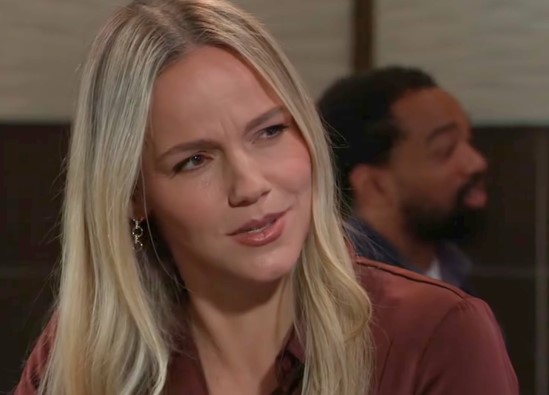
What makes that moment even more unsettling is how complete her trust sounded. Lulu wasn’t cautious or conflicted—she was certain. And that certainty may be the biggest red flag of all. Because while she believed she was leaning on someone who knew her, understood her, and shared a past with her, the version of “Nathan” standing in front of her has already begun to crack under closer scrutiny. The more she depended on him emotionally, the less she seemed to question whether he truly was the man she remembered.
Those cracks started small, almost easy to dismiss. Take the way he empathized with her coma. On the surface, it felt supportive—like he was trying to connect. But there was something off about it. The tone, the wording, the delivery—it didn’t feel lived-in. It felt performed. Lulu may not have consciously flagged it at first, but emotionally, something didn’t land. Real shared trauma has weight. What he offered sounded like an imitation of it.
Then there’s his strange fixation on Dante. For someone who hasn’t been back in Lulu’s life that long, “Nathan” seems unusually interested in probing her past with Dante—asking questions that go beyond casual curiosity. It’s not just about understanding Lulu’s history; it feels like gathering information. That subtle shift—from emotional partner to quiet observer—adds another layer of suspicion. And once that thought enters the picture, it becomes harder to ignore.
The moment that may have truly shaken Lulu, though, is tied to his confrontation with Britt. When he coldly insisted that Rocco needed his mother—and that Britt wasn’t it—it didn’t just come across as harsh. It felt wrong. Not just morally, but personally. The Nathan Lulu knew had empathy, restraint, and an instinct to protect, not provoke. That line wasn’t just brutal—it was revealing. And whether Lulu witnessed it firsthand or heard about it later, it likely forced her to confront a truth she hadn’t wanted to face.
As these moments begin to stack up, a pattern emerges. It’s not one big mistake—it’s a series of small inconsistencies. The missing emotional depth, the probing questions, the behavioral shifts, the tonal differences. Add in the glaring gap of those missing years—the timeline that never quite lines up, the lack of clear memory, the absence of the kind of trauma someone should carry—and the picture becomes harder to deny. It’s not just that something is off. It’s that everything is.
And that brings Lulu to a turning point. She may not confront him right away. That’s not who she is. Instead, she watches. She listens more carefully. She starts comparing what she remembers with what she’s seeing now. The trust doesn’t disappear instantly—but it fractures. And once doubt enters, it changes everything. Because now, every word he says and every move he makes is being measured against a question she can no longer ignore: who is he, really?
That question opens the door to multiple possibilities, each more dangerous than the last. Is this man an imposter pretending to be Nathan? Is the real Nathan out there somewhere, hidden or controlled? Or is this truly Nathan—but altered, manipulated, turned into someone else entirely? No matter which answer proves true, the emotional fallout is the same. Lulu didn’t just reconnect with someone she loved—she may have unknowingly opened her life to a stranger.
That’s what makes her original statement so powerful in hindsight. Calling him “the best thing” wasn’t just a moment of gratitude—it was the calm before the storm. The more she leaned on him, the deeper she fell into a reality built on assumptions. And now that those assumptions are starting to unravel, the truth isn’t just going to hurt—it’s going to redefine everything she thought she knew.
Lulu didn’t miss the clues. She trusted past them. And now, as those hidden details begin to align, she’s getting closer to a realization that could change her story forever. Because if this isn’t Nathan, then the question isn’t just who he is—it’s how long he’s been lying, and what he really wants.
